

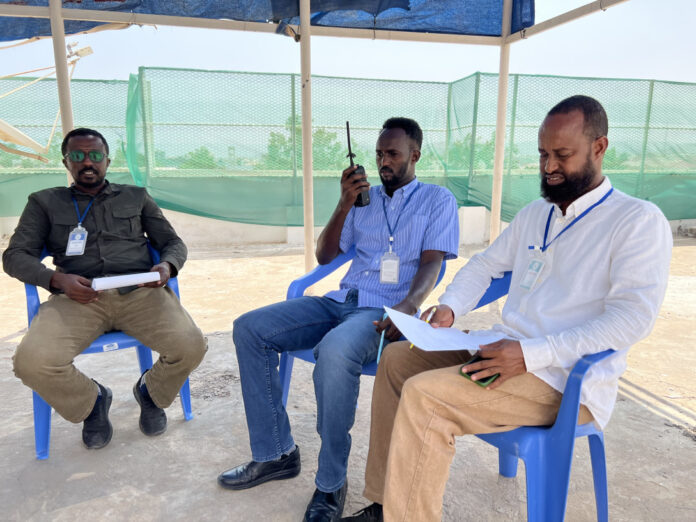
GAROWE, Somalia — The EUCAP Field Office in Puntland has concluded a maritime radio communications training for 16 officers from the Puntland Maritime Police Force (PMPF), aimed at strengthening operational capabilities in maritime safety and security.
The training, held from August 24 to September 3, 2026, focused on practical maritime communications skills and the effective use of radio systems and safety equipment in routine and emergency situations.
Participants received instruction on the Global Maritime Distress and Safety System (GMDSS), Very High Frequency (VHF), High Frequency (HF) and Medium Frequency (MF) radio systems, as well as Emergency Position-Indicating Radio Beacons (EPIRBs), Search and Rescue Transponders (SARTs) and NAVTEX.
The course also covered international distress, urgency and safety procedures, alongside relevant legal and regulatory frameworks governing maritime communications.
During practical VHF exercises, the officers applied standardized communication procedures in both routine operational scenarios and simulated emergencies, including situations requiring search and rescue coordination.
All 16 participants successfully obtained the Short-Range Certificate (SRC), confirming their competence in maritime VHF radio communications.
The certification is expected to enhance the PMPF’s operational readiness and strengthen its ability to communicate and coordinate effectively during maritime security operations and emergency response activities along Puntland’s coastline.
Speaking at the conclusion of the training, PMPF officer Khadar said the course had increased his confidence in using VHF communications and responding appropriately to safety, urgency and distress calls.
“These skills will help me communicate and coordinate more effectively during routine operations and, especially, in emergency and search and rescue situations,” he said.
The training forms part of broader efforts to strengthen maritime law enforcement and safety capabilities in Puntland, where effective communication remains critical for responding to incidents at sea and coordinating search and rescue operations.